Built for Africa: Who We Are

Across Africa and many emerging markets, interest in investing has never been higher. People follow global markets, study companies, compare returns, and talk about wealth-building with a seriousness that would surprise anyone who still believes the old clichés. What has not kept pace is access. For most people on the continent, the world’s deepest and most liquid markets, the U.S. exchanges where global companies list and global capital trades, remain out of reach, or reachable only through channels that are informal, expensive, or impossible to verify.
Coinsolation exists to close that gap properly. We are a research-driven investment company building a clear, regulated route for eligible investors, particularly in Africa and other emerging markets, to access U.S.-listed financial markets: exchange-traded funds, U.S. equities, and, selectively, regulated Bitcoin-linked instruments. One structure, professionally built, for access that has usually been informal, expensive, or out of reach.
It is worth being precise about what sets this apart. Plenty of routes now offer some access to global markets; that by itself is not unusual. What is less common is pairing that access, inside one regulated fund, with measured exposure to Bitcoin: the largest and most established digital asset, and the only one we hold. The order matters here too: Bitcoin is volatile and can fall sharply, so where we include it, it is deliberately sized and reached only through regulated, U.S.-listed, exchange-traded instruments, never a crypto exchange, private keys, or self-custody. Access to global markets and a disciplined route to a single digital asset, in one regulated structure: that is the combination. The restraint around it is deliberate.
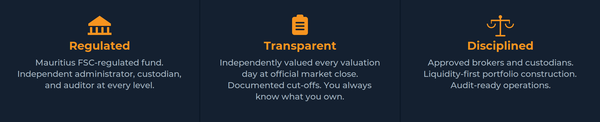
It matters just as much to say what we are not. We are not a crypto exchange. We are not a trading app promising instant riches. We are not an informal club or a signal group. Coinsolation is a fund: a regulated collective investment vehicle with independent oversight, documented processes, and institutional-grade controls at every layer. Our fund is licensed by the Mauritius Financial Services Commission (FSC), one of Africa’s most established international financial centres, with registered operations in both Africa and the United States.
The distinction is not cosmetic. A regulated fund must know exactly what it holds and value it independently. It must use approved custodians so client assets are segregated and protected. It must submit to independent administration and audit, so that the numbers you see are not simply the numbers we choose to show you. Every one of those obligations exists to protect the investor, and every one of them is a discipline we welcomed by choosing this structure.
Who is this for? The fund is designed for eligible investors, individuals and institutions who meet the qualification standards set out in the fund’s offering documents. That is a deliberate choice, and a protective one: it matches the fund to investors with the capacity to evaluate it properly. But this newsletter is for everyone. The education we publish here assumes no prior expertise and asks for no commitment, because a better-informed market is good for every investor in it, whether they ever subscribe or not.
This newsletter is the other half of the commitment. Access without understanding is not empowerment, so every month we will explain, in plain language, without jargon or hard sells, what we are building, how global markets actually work, and what you should demand from anyone who asks to manage your money. Whether or not you ever invest with us, we want you to be a sharper, better-protected investor for having read along.
This newsletter is for general information and education only. It is not an offer to sell, or a solicitation to buy, any securities or investment products. Coinsolation International Ltd is a Mauritius FSC-regulated Expert Fund open only to eligible Expert Investors. The fund is not registered with the U.S. SEC. Investing involves risk, including possible loss of capital. Always refer to the fund’s offering documents before making any investment decision.